Cold Storage Monitoring: How to Stop a Failed Compressor From Becoming a $10,000 Problem
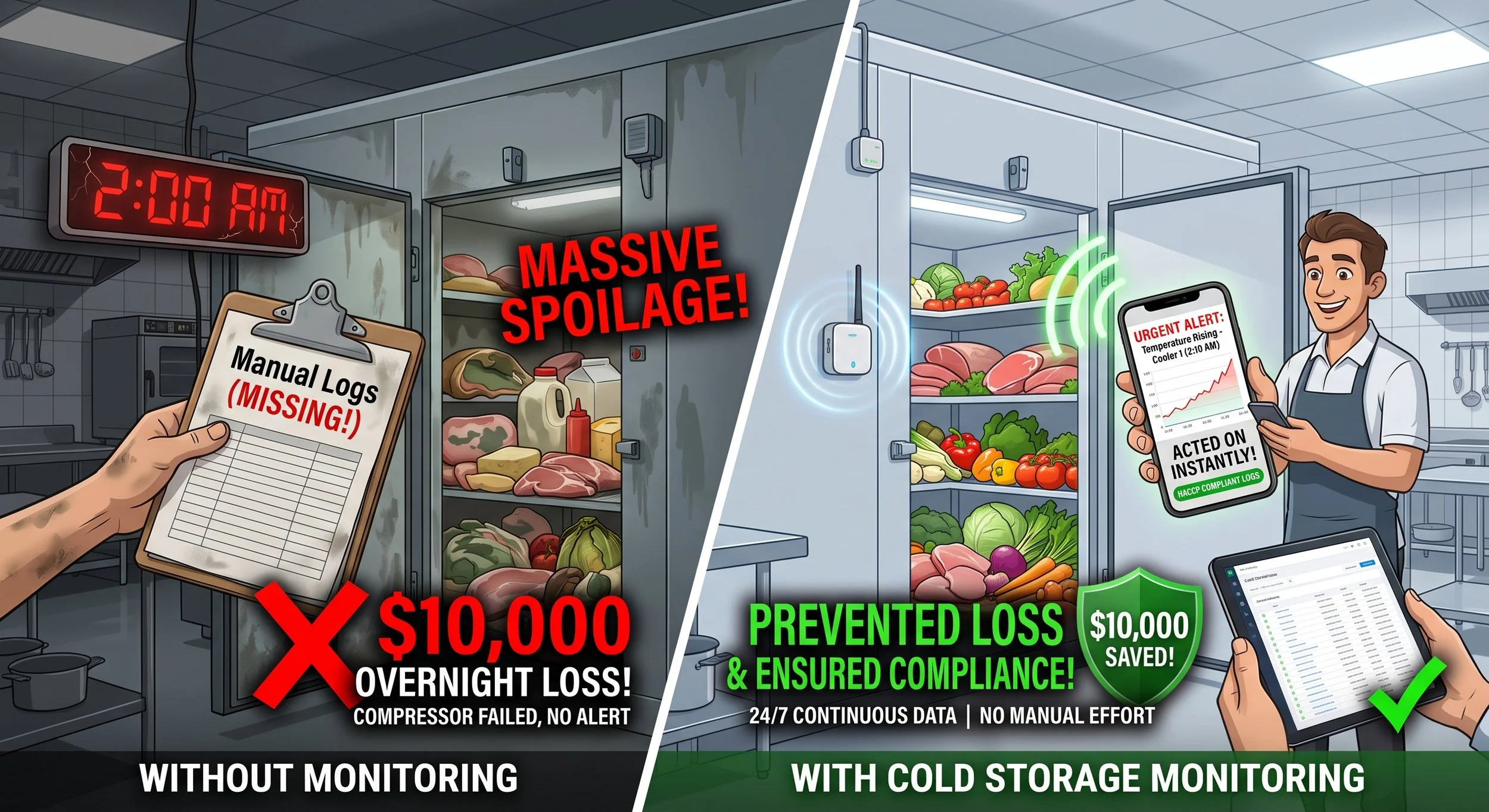
It's 2 a.m. Your walk-in cooler's compressor dies. Nobody's in the building. By the time your morning prep cook opens the door, the temperature's been climbing for six hours — and everything inside it is garbage.
That's the scenario cold storage monitoring exists to prevent. Not because a sensor is exciting technology, but because one missed alarm can wipe out a week of margin in a single night.
What Is Cold Storage Monitoring?
Cold storage monitoring is a system of wireless sensors placed inside walk-in coolers, freezers, and refrigerated cases that continuously track temperature (and often humidity) and send an alert the moment something drifts outside a safe range — day or night, whether anyone's on-site or not.
It replaces the two things most food service operators still rely on:
The clipboard — someone manually checks and logs temps a few times a shift, which means a failure between checks goes unnoticed for hours.
Hope — that nothing breaks overnight, on a Sunday, or during the one week the manager's on vacation.
Why Restaurants, Delis, and Butchers Actually Need This
You don't need a study to tell you spoiled product costs money. But it's worth putting a number on what's actually at stake:
Spoilage loss — a single walk-in full of proteins and dairy can represent thousands of dollars in inventory. One overnight failure can erase it all.
HACCP and health inspection risk — inspectors want documented, continuous temperature logs, not a clipboard with gaps and guesses. Automated logs are audit-ready by default.
Equipment life — a compressor that's struggling (running long, cycling oddly) often shows early warning signs in temperature data before it fails outright. Catching that trend early is cheaper than an emergency service call.
Staff time — manual temp checks eat labor hours every single shift, for a job a sensor does continuously and more accurately.
How Cold Storage Monitoring Actually Works
Good systems follow the same basic pattern, regardless of vendor:
Sensors go in — wireless temperature (and humidity) sensors are placed in each cooler, freezer, or case. No wiring, no downtime, no disruption to service.
Data flows to a live dashboard — you (and whoever else needs visibility) can check real-time readings from a phone or computer, anytime.
Alerts fire the moment something's wrong — a temperature excursion triggers an immediate alert, not a note someone finds at the next manual check. The event gets logged automatically for compliance records.
The value isn't the sensor. It's the alert arriving in time for someone to actually do something — move product, call a repair tech, or catch a door left ajar — before it becomes a total loss.
What to Look For in a Cold Storage Monitoring System
Not all monitoring is equal. Before you commit to a system, check for:
24/7 continuous monitoring — not spot checks, not once-an-hour polling with a lag.
Fast alert response — the gap between "temp goes out of range" and "someone gets notified" should be measured in seconds, not minutes.
Zero or low hardware cost, plug-and-play install — you shouldn't need an electrician or a construction project to get sensors running.
No long-term contract lock-in — month-to-month or a short pilot period lets you prove the value before committing.
A dashboard that generates audit-ready logs automatically — so when the health inspector asks for records, you're not scrambling.
A team behind the data, not just raw numbers — a system that tells you something changed is less useful than one that helps you understand what it means and what to do next.
The Real Cost of Not Monitoring
Ask any operator who's lived through a weekend compressor failure: the sensor pays for itself the first time it prevents a loss. The math is simple — a monitoring system costs a fraction of what a single spoiled walk-in represents, and it runs quietly in the background until the one night it matters most.
FAQ
How much does cold storage monitoring cost? Pricing varies by vendor and site count, but most modern systems are priced as a low monthly fee per location rather than a large upfront investment — often with no long-term contract required.
Does cold storage monitoring help with HACCP compliance? Yes. Continuous, automated temperature logging gives you a documented, timestamped record for every cooler and freezer — exactly what health inspectors and HACCP audits look for, without relying on manual clipboard checks.
Can I monitor multiple restaurant locations from one dashboard? Yes — this is one of the biggest advantages over manual checks. A single dashboard can show real-time status across every site, so a multi-location operator doesn't need boots on the ground at each one to know what's happening.
What happens when a sensor detects a problem? A properly configured system sends an immediate alert (typically via text, app notification, or email) to designated staff, and logs the event automatically for later reference — no manual write-up required.
Data Ladle installs wireless sensors that give restaurants, delis, and butchers real-time visibility into refrigeration, HVAC, plumbing, and electrical systems from one dashboard — 24/7 monitoring, fast alerts, and audit-ready logs, with no long-term contract. Based in Hammonton, NJ, serving NJ, PA, and DE.
📞 609-200-0373 · ✉️ Contact@DataLadle.com · 🌐 DataLadle.com